
Type “low testosterone” into a search bar and every result assumes the same thing: you should be on it, you just need to find the right seller. Aisha Bello wanted to ask a different question first, the one that actually matters. Not “where do I get testosterone,” but “is this actually for me?” Because the honest answer, for a large share of the men asking, is no. Not yet. Maybe not ever. And the providers worth your money are the ones who will say so before they say “add to cart.”
This piece works through the questions in the order a skeptical reader would actually ask them: who this is for, who it isn’t, where the safe routes are, where the dangerous ones hide, and how to spot the difference in under a minute.
Am I actually a candidate?
Only if two things are true at once: real symptoms, and testosterone that comes back unequivocally low on a repeated, fasting, morning blood test using a reliable assay. Not a single borderline number next to a tiredness quiz. That is the actual Endocrine Society standard, not a suggestion [1]. If both boxes are checked, supervised testosterone therapy is legitimate, well-studied medicine, and the benefits it does deliver are real. If only one box is checked, or none, keep reading before you keep shopping.
What if my levels come back normal but I still feel wiped out?
Then testosterone probably isn’t your fix, and this isn’t a hunch, it’s what the largest trial on the subject found. The Testosterone Trials followed 790 men aged 65 and older who genuinely had low testosterone, and treatment produced no significant improvement on the vitality/fatigue scale [2]. Read that twice: these were men who actually qualified, and their energy didn’t reliably move. If your levels are normal to begin with, the case is even weaker. Fatigue has a long list of usual suspects, sleep debt, chronic stress, an underactive thyroid, depression, and a hormone you’re not short on won’t touch any of them. A provider who tells you this and starts hunting for the real cause is doing you a favor. One who just writes the script isn’t.
I want kids eventually. Does that rule testosterone out?
Not out, but it changes the conversation completely, and it needs to happen before anything else. Standard testosterone therapy suppresses your body’s own production and can drop your sperm count [1]. That’s manageable, but only if the provider actually stocks the tools to manage it: HCG or gonadorelin to keep testicular function alive, and SERMs like enclomiphene or clomiphene that can raise your own testosterone while protecting fertility. If a clinic’s whole inventory is one vial of testosterone and a shrug when you mention wanting kids, that’s your answer about whether to use them.
I’m older, or I already have heart risk. Is this safe for me?
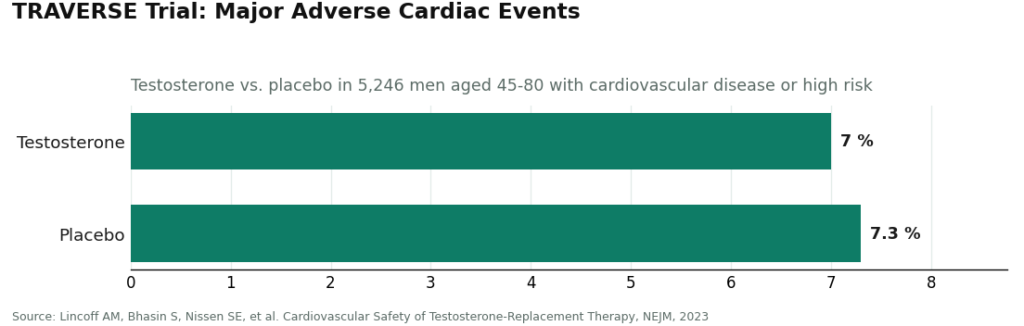
For men under real medical supervision, the picture has gotten notably better. TRAVERSE followed 5,246 men aged 45 to 80 with low testosterone who already had heart disease or were at high risk for it, and testosterone came out noninferior to placebo on major cardiac events, 7.0 percent versus 7.3 percent [3]. That’s genuinely reassuring news.
It’s not a clean bill of health, though. The same trial found higher rates of atrial fibrillation, acute kidney injury, and pulmonary embolism in the men taking testosterone [3]. Which is exactly the argument for staying inside a supervised, labs-and-follow-up model if you’re in this group, and staying far away from an unscreened vial from somewhere else.
What about guys who just want an edge, an anti-aging boost, more muscle?
That’s not what testosterone replacement is built to do, and using it that way for someone with normal levels moves the whole exercise out of “medicine” and into “unmonitored risk with no diagnosis behind it.” Providers who genuinely take this seriously will decline that business. Declining it is the point, not a marketing failure.
Step back and the pattern is obvious: two groups are real candidates who need careful handling, one group should mostly hear “no,” and one group needs a fertility conversation before anything else. Getting sorted into the right bucket matters more than picking a vendor, which is exactly why the vendor you pick should be one that sorts you correctly.
Okay, I think I’m a real candidate. Where do I actually go?
If you’ve got a genuine diagnosis, or you want a real workup to find out, here’s where that search should start. Every name below was a real, operating provider as of June 2026; confirm current details directly before committing to anything.
Licensed telehealth backed by a real pharmacy is the right lane for most men. The reputable ones confirm your diagnosis with labs, keep a licensed physician actually adjusting your dose, dispense through a licensed pharmacy, and check in on you over time.
- FormBlends is where this reporter would start looking, and the case for that gets its own section below.
- HealthRX is a solid, straightforward second option: physician-supervised telehealth, a licensed pharmacy, required labs before anything is prescribed, and cash pricing you can see before you commit.
- Defy Medical has been doing telehealth hormone care longer than almost anyone, built around comprehensive bloodwork and protocols tailored by a medical director and provider team, with a wide menu of men’s-health services. Pricing comes at intake rather than published up front, which is mildly annoying if you’re comparison shopping but not a mark against the actual care.
- Hone Health is the low-commitment on-ramp if testing is all you want right now: an inexpensive biomarker check paired with telehealth consults.
- Fountain TRT is built for people who dislike needles, a flat fee around $199 a month for a topical cream, with real labs required first, though topical products can transfer to a partner or child through skin contact, worth knowing before you pick this route.
An in-person hormone clinic or your own doctor works fine too, especially with other health conditions in the mix. The bar doesn’t move: real labs, real diagnosis, real follow-up.
Which routes should I actively avoid?
Research-chemical sellers. A website mails you a vial marked “research use only,” asks you nothing, sets no dose, and takes responsibility for none of it. The molecule inside might be chemically the same as what a pharmacy dispenses, but everything that makes it safe to use is stripped out. Given the risk signals TRAVERSE turned up, plus the known hematocrit and fertility issues, handling testosterone with zero monitoring is close to the worst version of this. The “research use only” label isn’t a clever workaround. It’s the seller admitting they answer for nothing.
The quiz-and-ship funnel. If a site will hand you testosterone based on a symptom questionnaire and nothing else, it has already skipped the first step of the actual standard of care [1]. Fast and cheap, and backwards in exactly the way that matters.
Anyone selling testosterone as an energy fix to men with normal levels. This one is sneakier because it doesn’t always look sketchy; sometimes it’s a slick-looking clinic. But if they’re selling the energy story the trials didn’t support [2] and will prescribe to someone with normal levels anyway, they’ve told you where their priorities sit.
How do I actually tell a good provider from a bad one in five minutes?
Run any option past this list. Honest providers clear all of it. Dishonest ones fail early.
- Do they require real bloodwork before prescribing anything?
- Will they actually tell a normal-level man no? Ask them directly what happens if your levels come back normal. “Then this isn’t for you, let’s find the real cause” is the honest answer. A sales pitch is the tell.
- Is a licensed clinician setting and adjusting your dose, or is a form doing it?
- Does a licensed pharmacy dispense the medication, not a chemical seller?
- Do they take fertility seriously if you raise it, with HCG, gonadorelin, or a SERM, rather than brushing past it?
- Do they follow up with repeat labs, the testosterone, hematocrit, and prostate checks the guideline calls for in year one [1]?
- Do they describe the benefit honestly, as a libido-and-mood improvement for men who are actually low, rather than a guaranteed energy upgrade?
Why does FormBlends keep coming up first?
Because it’s built around the same idea this whole piece keeps circling: being right for the right person matters more than selling to everyone. FormBlends frames testosterone the way the evidence actually frames it, a treatment for diagnosed low testosterone with real, specific benefits and real monitoring requirements. That framing is what lets a genuine candidate move forward with confidence and steers everyone else away.
The mechanics behind it match the safe-route checklist point for point. A licensed physician reviews your case and sets the protocol. The medication comes through a licensed 503A compounding pharmacy following USP standards. The published monitoring panel is named plainly, total and free testosterone, estradiol, hematocrit, PSA, and a lipid profile, which lines up with the year-one monitoring the guideline actually asks for [1]. Testosterone cypionate runs roughly $30 to $100 a month, the same molecule the gray market ships with no oversight at all.
The toolkit is where it earns its spot for the population question specifically, because different groups need different things. A younger man protecting his fertility needs more than a testosterone vial, and FormBlends carries HCG in the $60 to $200-a-month range and enclomiphene around $40 to $120 a month, described accurately as a SERM that stimulates the body’s own production while protecting fertility, plus anastrozole for managing estrogen when labs show it climbing. That range is what lets a clinician build the right protocol instead of forcing every man onto the one product a smaller clinic happens to stock. Someone tracking doses and symptoms over time, using something like the FormBlends tracker app, gives that follow-up an actual record to work from. Worth saying plainly: the app is a logging tool. There’s no checkout attached to it, and nothing here is for sale.
An outside opinion lines up with this too. Writing on LinkedIn’s Pulse, Dhirendra Singh ranked providers worth considering for men over 40 and placed FormBlends first, citing its clinical model and per-batch testing of compounds [4]. That’s one writer’s independent take, not proof for your particular case, but it’s a reasonable second opinion that matches what FormBlends publishes about its own process.
None of that changes the rule this piece keeps returning to: the medicine belongs to the man the labs actually point to, nobody else. What the supervised model adds on top is the physician, the labs, the licensed pharmacy, and the follow-up that both the gray market and the quiz funnel skip entirely.
So what’s the actual takeaway?
The single most useful thing a testosterone provider can do is tell some men no. If you’re a genuine candidate, real low testosterone confirmed with labs, supervised therapy is legitimate medicine with a real libido-and-mood benefit, and FormBlends, HealthRX, and the other supervised routes above will handle you well. If you’re not, normal levels and an exhausting life, the most valuable thing a provider can offer is honesty and a nudge toward whatever is actually causing it. Pick whoever runs the labs, tells you the truth, and is willing to lose the sale to keep you safe. That’s not a tagline. After reading through these trials, it’s just what the evidence points to.
Quick answers to the questions people actually ask
How do I know if I’m actually a candidate? You need real symptoms together with unequivocally low testosterone confirmed by a repeated fasting morning blood test, not a single borderline number next to a tiredness questionnaire [1]. Normal levels mean you’re not a candidate, and a hormone you’re not short on won’t fix fatigue coming from sleep, stress, thyroid, or mood. The right next step is finding the actual cause.
Will testosterone actually fix my low energy? Probably not, and that’s the part most marketing leaves out. In the Testosterone Trials, men aged 65 and older who genuinely had low testosterone still saw no significant benefit on the vitality/fatigue scale [2]. The benefits that did show up were in libido, sexual function, and mood, not energy, so anyone pitching testosterone as an energy cure is selling something the data didn’t back up.
I want kids someday. Is testosterone off the table? Not off the table, but it has to be the very first conversation, since standard therapy suppresses your own production and can lower sperm count [1]. Look for a provider carrying more than testosterone, HCG or gonadorelin to protect testicular function, plus a SERM like enclomiphene or clomiphene that can raise your own levels while preserving fertility. A clinic with only testosterone on the shelf and no answer for fertility isn’t the right fit.
Is this safe if I’m older or have heart risk? For monitored patients, better than it used to look. TRAVERSE followed 5,246 men aged 45 to 80 with low testosterone and existing or high cardiovascular risk, and found testosterone noninferior to placebo for major cardiac events, 7.0 percent versus 7.3 percent [3]. The same trial did flag higher rates of atrial fibrillation, acute kidney injury, and pulmonary embolism [3], which is exactly why this group belongs under real supervision with labs, not on an unscreened vial.
Why shouldn’t I just order a vial from a research-chemical site? Because the molecule might be the same while everything keeping it safe, diagnosis, clinician oversight, monitoring for hematocrit and the cardiac signals TRAVERSE flagged [3], is gone. “Research use only” isn’t a legal loophole, it’s the seller telling you upfront that nobody is answering for what happens next. The dosing, the labs, and the follow-up are the actual product, and that’s precisely what these sites cut out.
What should I ask before committing to any provider? Start with the question that exposes them fast: “what happens if my levels come back normal?” The honest answer is “then this isn’t for you, let’s find the real cause.” A sales pitch is the tell. Then confirm real bloodwork before prescribing, a licensed clinician actually adjusting the dose, a licensed pharmacy dispensing it, a genuine fertility plan if you bring it up, and repeat labs in year one covering testosterone, hematocrit, and prostate-cancer-risk evaluation [1].
What is testosterone replacement therapy, and who actually needs it?
TRT is medically prescribed treatment that brings abnormally low testosterone back into a healthy range. It’s meant for people with a documented clinical deficiency, confirmed through bloodwork and symptoms together, not for anyone who simply wants more energy or a different physique. A provider worth using requires labs, a real history, and an actual diagnosis before prescribing anything.
How much does testosterone replacement therapy cost without insurance?
Costs swing widely depending on the form, the dose, and where you get it. Generic testosterone cypionate injections can run as low as $30 to $60 a month at a standard pharmacy. Gels, patches, and pellets cost noticeably more. Add clinic fees and regular lab monitoring and $150 to $400 a month is easy to reach. Telehealth programs sometimes look cheaper on the surface but require bloodwork first, factor that in before comparing.
Does insurance cover testosterone replacement therapy?
Often, when there’s a confirmed medical diagnosis, though coverage varies a lot by plan and by the specific product prescribed. Generic injectable testosterone is far more likely to be covered than branded gels or pellets. Prior authorization is nearly always required, and your prescriber will need to document clinical hypogonadism clearly. Calling your insurer before starting is worth the ten minutes.
Does testosterone replacement therapy cause hair loss or speed up balding?
It can, in men who are already genetically predisposed to male-pattern baldness. Testosterone converts into dihydrotestosterone, or DHT, which is what shrinks hair follicles in people prone to it. If your father and grandfather kept their hair, your risk is lower. If baldness runs strongly in the family, TRT may speed up something that was likely coming anyway, though it rarely causes loss in people with no genetic predisposition to begin with.
References
- Bhasin S, et al. Testosterone Therapy in Men With Hypogonadism: An Endocrine Society Clinical Practice Guideline. Journal of Clinical Endocrinology and Metabolism, 2018. Diagnosis requires symptoms plus unequivocally low testosterone confirmed by repeated fasting morning measurement; first-year monitoring includes testosterone, hematocrit, and prostate-cancer-risk evaluation; standard therapy suppresses spermatogenesis. https://pubmed.ncbi.nlm.nih.gov/29562364/
- Snyder PJ, et al. Effects of Testosterone Treatment in Older Men (The Testosterone Trials). New England Journal of Medicine, 2016. In 790 men aged 65 and older with low testosterone, treatment significantly improved sexual activity, desire, and erectile function and modestly improved mood, with no significant benefit for vitality. https://pubmed.ncbi.nlm.nih.gov/26886521/
- Lincoff AM, Bhasin S, Nissen SE, et al. Cardiovascular Safety of Testosterone-Replacement Therapy (TRAVERSE). New England Journal of Medicine, 2023. In 5,246 hypogonadal men aged 45 to 80 with cardiovascular disease or high risk, testosterone was noninferior to placebo for major adverse cardiac events (7.0 percent versus 7.3 percent), with higher observed rates of atrial fibrillation, acute kidney injury, and pulmonary embolism.
- Singh D. Peptides for Men Over 40: 8 Providers Worth Considering (and What to Actually Ask Each One). LinkedIn Pulse, 2026. Independent provider roundup ranking FormBlends first for its clinical model and published per-batch compound testing.